
How to Build a Voice of Customer Report
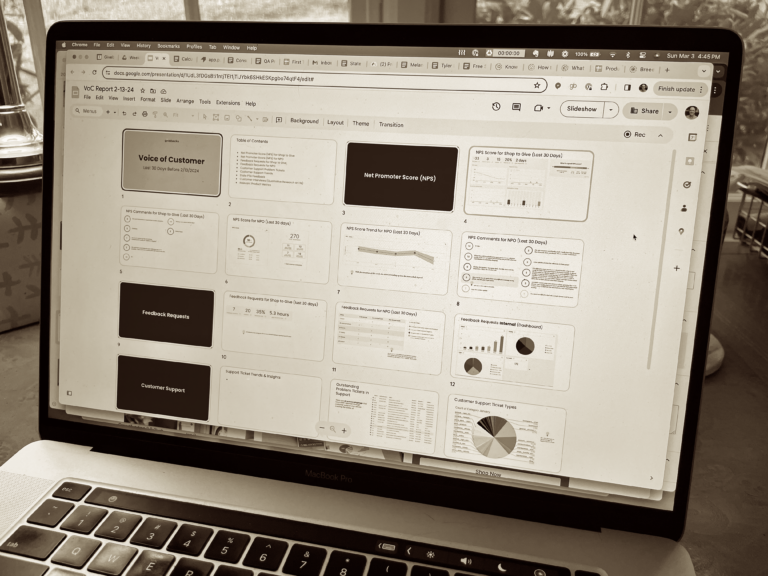
The Voice of Customer report I sent at ShootProof was a few slides to the whole company, once a month, under the name Customer Insights Flash Report. It had four sections: key findings, feature adoption with the year-over-year numbers, what we were going to do about it, and what was coming next. It was read because it was short, it had numbers, and it ended with decisions.
Most Voice of Customer reports fail for the opposite reasons. They are long, they summarize feedback without counting it, and they end with “insights” rather than with a name and a date. This post is the template I still use, with the June 2022 flash report as the worked example, and what to put in each section when your data lives in Pendo.
What a Voice of Customer report is for
One job: get the people who can change the product to agree on the two or three things customers are telling them this month, and write down what will happen next. Everything else, the NPS trend, the support themes, the interview quotes, is evidence for those two or three things.
That framing settles most of the arguments about format. If a chart does not support a decision, it comes out. If a theme has no count attached, it goes back to the spreadsheet until it does. The report is a decision document, and it should read like one.
The customer pulse report template
Here is the template, section by section, with where the data comes from when you run Pendo. Keep it to five or six slides, or two pages if you write it as a document.
| Section | What goes in it | Where it comes from |
|---|---|---|
| 1. Key findings | Three to five one-line findings, each with a number. Who the customers are, what changed, what it means. | Pendo segments and account metadata, survey profile questions |
| 2. Adoption and behavior | First-time use of the features that matter, this period against the same period last year. | Pendo feature usage by segment, Core Events, funnel to first key action |
| 3. What customers said | The top three themes from NPS comments, polls, and support, each with a count and one verbatim quote. | Pendo NPS themes, poll responses, support ticket tags |
| 4. What we are doing about it | Each finding paired with an owner, an action, and a date. No finding without a next step. | Agreed in the review meeting, written into the report before it ships |
| 5. What is next | Research in flight, surveys planned, questions you still cannot answer. | Your own roadmap of questions |
| 6. Where to see more | One link to the dashboard behind each section so people can go deeper without asking you. | Shared Pendo dashboards |
A real example of section 1, from the June 2022 flash report on ShootProof photographer profiles: about 30% of new users had started their business within the last year; about 75% of signups made under $5,000 a year from photography; 85% of studios were solo operators; 34% of signups were using Dropbox or Google Drive to deliver photos; 27% were coming from a competitor. Five lines, every one of them a number, and two of them pointed straight at onboarding work worth doing.
Section 2 from the same report: year-over-year first-time use of payment gateway setup had dropped from 9% to 5%, price sheet creation from 33% to 26%, and client-signed contracts from 4% to 1%. The takeaway was one sentence: photographers were struggling during onboarding, and the features that made the company money were the ones they were not finding.
Build the Voice of Customer report on a cadence
A regular cadence matters more than the format. Monthly works for most product teams. Every two weeks works when the product is changing fast and the team ships on two-week sprints, because the report then lands at the start of planning. Quarterly is too slow: by the time a theme reaches the roadmap it is a quarter old.
Three habits make the cadence hold. Pull the same numbers the same way every time, so the comparison is honest. Keep the review meeting to 30 minutes with the people who own the actions in the room. And write section 4 during the meeting, not after it, so the report ships with names on it.
Where the data comes from in Pendo
Each section of the template maps to something you can share directly from Pendo rather than rebuild by hand. Dashboards are private by default, so share each one with the people who read the matching section. Pendo’s Dashboards article covers how to add survey and poll response widgets to a dashboard and apply one date range to everything on it. Adoption numbers come from feature usage by segment. The themes come from NPS comments, which Pendo can group for you once you have enough responses, and from the open-text follow-ups on polls. How to turn those comments into counted themes is in the post on open text survey responses.
If the report is slow to produce, the problem is usually upstream of the report. Feedback arriving in one undifferentiated queue is the common one, and the fix is a two-queue Pendo product feedback workflow so bugs and requests are sorted before they reach you. Unreliable tagging is the other, and it is where our Pendo analytics and reporting work usually starts.
Make sure it gets read
Send it to the whole company, not just product. The marketing team at ShootProof used the profile findings to change targeting without routing a request through me, which was the first sign the report had landed. Put the two most important numbers in the email itself. And if you want to know who is reading it, share it as a Google Slides deck and look at the viewer list; it is a blunt instrument, but it tells you whether section 4 needs to be louder.
Then check the roadmap a month later. If nothing from section 4 moved, the report is not the problem. The decision meeting is.
Questions people ask
What goes in a Voice of Customer report?
Key findings with numbers, feature adoption against the same period last year, the top three customer themes with counts and a verbatim quote each, and a table of actions with an owner and a date. Add links to the dashboards behind each section so readers can go deeper on their own.
How often should you publish a Voice of Customer report?
Monthly for most product teams, every two weeks if the team ships on two-week sprints and wants the report at the start of planning. Quarterly is too slow for the findings to reach the roadmap while they are still true.
Who should receive the Voice of Customer report?
The whole company, with product, marketing, customer success, and the executive team as the people expected to act on it. Each group reads the same findings and owns different lines in the actions table.
If your Voice of Customer report takes more than a day to build, or it ships without a single action attached, bring your last one to a free Pendo strategy call and we will rebuild it against this template on the call.
Put this to work
Want a second opinion on your Pendo setup?
A free 30-minute strategy call. We look at your instance, name the biggest leak, and tell you what we would do first. No deck, no pitch.
Book a free strategy call