Pendo Case Study: Vertical IQ, 86% Faster Time to Value
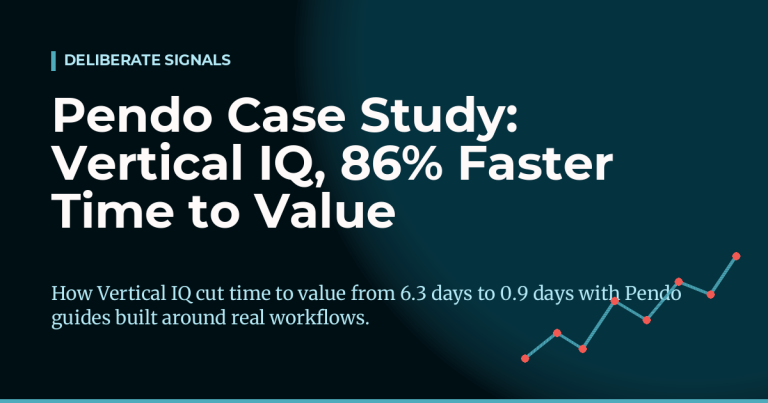
This is a Pendo case study with the numbers attached, because the question I get on almost every first call is some version of: fine, but what did it actually change? Vertical IQ is the clearest answer I have. New users who completed onboarding reached the product’s most valuable feature 86% faster, from 6.3 days to 0.9 days, and the system behind that number is one any B2B SaaS team with Pendo can copy.
Vertical IQ sells industry intelligence to banks and financial institutions: more than 1,600 industry profiles and 3,400 local economic reports that sales, marketing, and customer success teams use before they walk into a meeting. The content was strong and customer sentiment was high. The problem was the first week.
The problem: good product, slow first week
As new users came in from banks and credit unions, the product team noticed a pattern. First-time users were not always finding the most valuable features quickly. The default experience had no guidance, role-specific activation was inconsistent, and training lived in sessions that happened outside the product. The question on the table was simple: are users getting to value fast, or getting lost?
The stakeholders set four priorities, and they are worth copying as written:
- Replace outdated training with in-app, self-serve onboarding.
- Reduce guide fatigue and get users to their first useful moment faster.
- Drive earlier adoption of the platform’s high-value features.
- Use product behavior data to guide the roadmap and customer education.
What we built, week by week
The engagement ran a little over ten weeks. The order matters more than the speed, so here it is in sequence.
Weeks 1 to 2: foundations and audit
We reviewed the tagging strategy (tagging means naming the pages and features Pendo tracks so reports mean something), the events, and the user segments. We audited the existing guide flows and their performance, delivered the core configuration updates, and validated the product goals with the team. Nothing user-facing shipped in these two weeks, on purpose. The same discipline is in the first 30 days post: fix the data layer before you build on it.
Weeks 3 to 4: role-based segmentation and guide strategy
The first thing users saw was a one-click role selection guide. One question, one click, and from then on Pendo knew which journey the person was on. That guide reached a 95% completion rate, which is as close to free segmentation as you will get. We mapped the journeys for each key persona and set up Pendo goals and benchmarks tied to what each role was trying to do.
Weeks 5 to 9: guide rebuild and the analytics loop
With roles known, we rebuilt onboarding for the highest-value segment around the workflows people actually run, not the feature list. The Resource Center and contextual nudges were integrated into the Industry Dashboard. Then we iterated on funnel data and drop-off analysis every week. Time to first use for critical actions came down by more than 50% during this phase.
Week 10 and after: dashboards, CS integration, feedback loops
We built onboarding dashboards to monitor guide performance, connected customer success, marketing, and product around the same metrics, and started the CSAT and CES integration for the feedback loop that comes next.
The Pendo case study numbers
Every figure below is time to value for new users who completed onboarding, measured in days from signup to first use of the feature, before and after the new onboarding.
| Action | Before | After | Change |
|---|---|---|---|
| Reach the valuable credit feature | 6.3 days | 0.9 days | 86% faster |
| Subscribe to updates | 6.8 days | 3.0 days | 56% faster |
| Print an industry profile | 5.1 days | 2.1 days | 59% faster |
| Reach actionable industry content | 3.4 days | 2.2 days | 35% faster |
Alongside the speed: a 62% onboarding completion rate for new users in the highest-value segment, a segmented onboarding system that now scales to new roles and features without rebuilding, and onboarding ownership moved from customer success to self-serve, which saves CS time on every new account. Pendo became central to activation, training, and the future customer feedback strategy rather than a tool one person checked.
Drake Branson, Director of Product at Vertical IQ, put it this way: “Deliberate Signals brought the Pendo expertise and onboarding experience we needed to accelerate execution with confidence. They filled a critical gap and helped us get it right the first time.”
Why it worked, and what to copy
This was not a cosmetic guide redesign. Three decisions did most of the work.
- Guides were mapped to real workflows. We watched what each role did in the product and built the path around it, instead of building a tour of the interface.
- We measured activation milestones, not clicks. Each guide had a goal, a page view or feature click that meant the person got somewhere. Pendo’s guide goals count a visitor as adopting the goal once they have seen the first step and later taken the target action, which is exactly the thing you want to know.
- We built a structure that survives the project. Role segment, journey map, goal per guide, dashboard per journey. The next role Vertical IQ adds slots into the same frame.
If you want the same shape for your own team, this is the work we do as a Pendo implementation partner: audit first, roles second, guides third, and a dashboard that tells you whether any of it moved a number.
What came next
With adoption up and the structure in place, the plan Vertical IQ set for itself was to A/B test new variants of the onboarding flows, expand role-based guides to the credit and advisory teams, bring in deeper CSAT and survey data to close the loop, and tie onboarding signals to retention and expansion. That is the right order, and it is the same order I would give any team that has just finished its first onboarding rebuild.
Questions people ask
How long does a Pendo onboarding project like this take?
This one ran a little over ten weeks: two weeks of audit and configuration, two weeks on roles and guide strategy, five weeks of guide rebuilding against funnel data, and the dashboards and CS hand-off after that. Smaller products move faster, and the audit is the part you should not shorten.
What is a good guide completion rate in Pendo?
It depends on the guide’s job. A one-question role selection guide reached 95% completion at Vertical IQ, while a multi-step onboarding flow for the highest-value segment reached 62%. Judge each guide against its goal, not against a single benchmark.
How do you measure time to value with Pendo?
Tag the feature that represents value, then measure days from a visitor’s first visit to their first use of it, split by segment. Pendo’s Time to First Use widget and guide goals do the counting once the feature is tagged and the segment exists.
If your first week looks like Vertical IQ’s did before this work, a free Pendo strategy call is the fastest way to find out which of these steps applies to you.
Put this to work
Want a second opinion on your Pendo setup?
A free 30-minute strategy call. We look at your instance, name the biggest leak, and tell you what we would do first. No deck, no pitch.
Book a free strategy call